
Assistance dogs: a lasting bond
Alex tells us about life with his assistance dog, Rosie. Alex shows us why we need more understanding of assistance dogs, and what makes Rosie such a brilliant, essential companion.
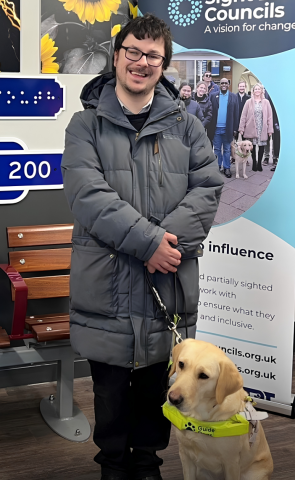
I live with my assistance dog, Rosie. Rosie is three years old, and she’s a cross between a yellow lab and a golden retriever. She’s a brilliant companion, and she helps me every day.
We use the term ‘assistance dogs’ for all dogs that help disabled people. This includes ‘guide dogs’ that help people with visual impairments, including me. I use both terms all the time.
I was born with an eye condition called Retinopathy of Prematurity (ROP). I have no vision in my right eye. The vision in my left eye is increasingly blurred. I struggle with bright lights so summertime can be tricky. Rosie is with me almost all the time – whether I’m moving around the house, whether I’m doing volunteer work or getting out and about.
A popular sidekick
Rosie has been an enthusiastic bundle of energy ever since she joined me a year and a half ago, and she’s gradually starting to settle down now! She’s proving crucial for my volunteering, and I couldn’t do what I do without her.
At the hospital, through the chaplaincy, I visit patients every week. Rosie helps me get there and get around so I can chat with a few people, and she’s hugely popular.
If I visit someone’s house, Rosie is by my side again. This could be a social visit to see family or friends, or it could be on a tech support visit with the charity AbilityNet. I help other disabled people who might have technology queries – both on the phone and sometimes in person.
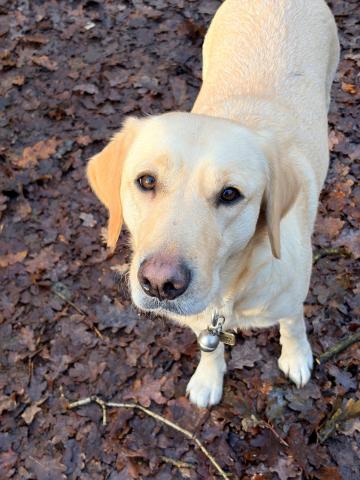
Theatre buddies
One of the things I love most is the theatre. On my review site theVIcritic.com, my posts about a play or a show will include accessibility notes for visually impaired people and other disabled people. Rosie seems to like the journey and the destination. She’ll happily accept a friendly greeting from staff and settle down with them while I go and watch the show. So I don’t know what Rosie thinks of the productions at The Mercury Theatre! Still, I’d say they are highly recommended.
Travel barriers
When I go out and about, we still face some all too familiar barriers. I’ve had countless refusals to take Rosie in taxis. Under the Equality Act 2010, drivers of taxis and minicabs have a legal duty to accept disabled passengers and assistance dogs. Drivers who refuse assistance dogs in their vehicle must carry and display a valid medical exemption certificate. A valid certificate must have backing from the licensing authority.
In nine out of ten recent taxi journeys I tried to take, taxi drivers would turn me down. And they wouldn’t have these certificates. So it was all very demoralising. People would often say: ‘I don’t want dog hair in the car’.
Now, I avoid using taxis wherever possible. This lessens my independence, for sure. I rely on the availability and the goodwill of friends and family.
Barred
Venue staff at many different companies will still deny entry to guide dogs; or they will ask people with guide dogs to leave.
Several visually impaired people said they couldn’t get into their local Wetherspoon’s pub with their guide dog. The story rightly gained national media coverage. In the past year, it happened to me too. I’ve been reluctant to go back.
Rosie had walked in with her guide dog harness on. I often remove it when she lies down – so she knows we’re not about to go somewhere immediately – but the harness will always be with us.
A staff member came over and said that Wetherspoons do not allow dogs in their pubs. I explained that Rosie is a guide dog. She appeared not to believe me, adding that without documentation I might have to leave. In the end, she was quite rude in the way she spoke to me. I felt upset and humiliated.
The staff member asked customers to display Assistance Dogs UK documentation, which I had at home. This followed a Wetherspoon’s policy (first introduced in May 2025) on all assistance dogs. However, Assistance Dogs UK rightly say there is no legal requirement for disabled people to carry and display this documentation. And so this Wetherspoon’s policy could be against the Equality Act.
Problems make me determined to campaign
Today, I make sure that I still keep going out. But when Rosie and I go to any venue – a pub, restaurant, café or wherever – I still think: ‘will Rosie be accepted? Are we going to have problems?’ It does worry me.
With more understanding of the vital importance of assistance dogs, people like me can live our lives the way we choose.
So it’s crucial for me to keep campaigning. I want to keep links with organisations that campaign with disabled people for a more equal society – including Guide Dogs UK, The Thomas Pocklington Trust, and of course Leonard Cheshire.
Help from other people, and paying for social care myself
I previously had local authority funded social care for about six hours per week. It helped me with cleaning and trips out. Then, about seven or eight years ago, I was told that I’d have to contribute to the cost of this social care package. This wasn’t possible for me, and that support ended.
Now I have a couple of hours of social care per week, and I pay for this myself. My support worker is great. As well as helping with cleaning around the house, she also checks what food I need in the fridge and she does a few errands.
I’m a huge fan of my local team, Colchester United. I have a season ticket for me and a personal assistant (PA). Rosie would find it too loud at the stadium. So, whenever possible, I’ll get help from a brilliant organisation called Game Day Vision. They find someone who can travel with me, take my PA ticket and support me at the match.
Public interactions
The public are usually fine with my guide dog day to day. People really warm to Rosie, as they did with my previous guide dog - Blossom. I like responding to people’s questions and talking about my dog. I still wish people wouldn’t pet Rosie without asking.
People should not try to pet or distract a dog that is wearing an assistance harness. The harness means it’s working. For safety in the short-term and the long-term, the dog must know when to keep its focus. Whenever it’s working, the dog’s focus must be on the owner.
People seem not to be aware of this. Every day when we’re out and about, several people will pat Rosie when she’s wearing the harness. It goes with the territory. I just shrug it off as best I can and deal with it.
New tech: sometimes pricey, still really encouraging
Like many young disabled people, I like to embrace opportunities with new technology. So I was delighted to try Meta glasses recently. It’s an exciting example of wearable tech that will explain to users what is in front of them. It’s not perfect, and right now it’s obviously a very expensive option. There might be apps that do the same thing.
Clearly, when it works, tech like this is lifechanging. A voice will explain what is around me; it will also describe the items I’m browsing through in a shop. All these developments should become more affordable, and it’s encouraging for the years ahead.
Strong, lasting bond
Whatever happens in the future, a dog like Rosie is essential for me. There’s a strong, lasting bond between an assistance dog and their owner. Undoubtedly, Rosie is a great find and an absolute star!
Related content
